More Social Media, Less Focus: The Longitudinal Study Parents and Schools Can’t Ignore
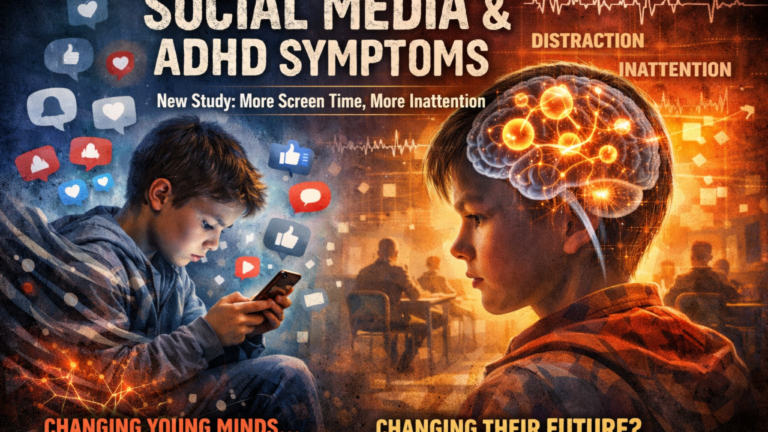
A new multi‑year study found that more social media use predicted rising inattention symptoms over time—even after accounting for genetics. Small effect per child. Big impact at scale.
What’s happening to our kids’ attention?
A major longitudinal study following thousands of children for four years found that more social media use was associated with a gradual increase in inattention symptoms over time—even after researchers accounted for genetics and baseline behavior.
The effect is small for any one child. But when millions of kids are exposed to the same design patterns every day, small effects can turn into a big shift in the “normal” level of focus across classrooms, schools, and entire communities.
This isn’t academic. It’s a warning sign for every parent, educator, policymaker, and leader: our digital environment may be reshaping young brains—and the future of focus itself.
What the longitudinal study found
What the study actually found (in plain language)
The research drew from the Adolescent Brain Cognitive Development (ABCD) Study and followed 8,324 children (starting around age 9–10) over four years. Kids reported how much time they spent on different types of digital media. Parents reported attention and behavior symptoms annually.
Here’s the key result: average social media use predicted increased inattention symptoms over time, with a cumulative effect across four years. TV/videos and video games did not show the same pattern.
Researchers also estimated genetic predisposition using a polygenic risk score and found the social media → inattention association was not explained away by genetics.
Translation: this pattern showed up even after accounting for “kids who were already wired this way.”
Why this matters for a safe school environment
Why “small effects” can be huge
If one child’s focus slips a little, you might not notice. But at scale, it changes:
- how long a class can stay on task
- how often teachers have to redirect attention
- how much learning time gets lost to distraction
- how stressful the environment feels for students who are trying to focus
That’s why this is a safe school environment issue. A classroom where attention is constantly fragmenting becomes less predictable, more emotionally charged, and harder for students—especially neurodivergent kids—to feel secure and engaged.
It’s not just time—it's the pull of platforms
It’s not just “screen time.” It’s the pull of platforms.
Social media isn’t built like a textbook or a documentary. It’s engineered for repeat engagement. Some of the biggest attention-draining drivers include:
- Intermittent rewards (likes, comments, streaks) that keep the brain “checking”
- Infinite scroll and autoplay that remove natural stopping points
- Notifications that train constant task-switching
- Algorithmic feeds that personalize temptation to the user
So when we talk about student safety at school and child safety in schools, we have to include the digital layer—because attention is part of safety. When focus collapses, learning suffers and behavior issues rise.
What schools can do right now
Ways to improve school safety: protect attention during school hours
This is where school safety policies need to evolve. Not as punishment—but as protection. Here are practical school safety best practices that schools can implement without turning the campus into a police state.
1) Create phone boundaries that protect safe classrooms
1) Build a clear school phone policy that creates “safe classrooms for students”
Policies like “bell to bell,” pouches, lockers, or structured phone-free blocks work best when they’re simple, consistent, and supported by parents.
Think of it as how to create a safe zone in schools: a predictable boundary where students can focus without social pressure, constant checking, or group-chat drama.
2) Add attention protection to school safety programs
2) Treat attention as part of school safety programs
Most school safety programs focus on physical risk. Add attention protection as a prevention layer:
- digital distraction education (short, practical, not preachy)
- teacher-friendly classroom norms that reduce device conflict
- support for students with higher vulnerability to distraction
This strengthens school safety awareness and improves day-to-day climate.
3) Train staff to reduce conflict and improve consistency
3) Train staff to handle digital distraction without escalation
Staff safety training schools should include de-escalation and consistency around devices. Students test boundaries. If enforcement is inconsistent, conflict rises. If it’s predictable, tension drops.
Include:
- simple scripts teachers can use
- clear referral paths (so teachers aren’t “the bad guy”)
- a consistent consequence ladder
What parents can do
School safety tips for parents: focus protection starts at home
Parents ask, “how schools keep students safe.” Here’s the other half: what home can do to make school policies actually work.
School safety checklist for parents (attention edition):
- Turn off non-essential notifications (especially social apps)
- No group chats during school hours
- Phone sleeps outside the bedroom
- Create a “stop point” rule (no infinite scroll before homework)
- Model it—kids follow what they see
If you’re wondering about signs a school is unsafe in the digital era: watch for chronic distraction, constant phone conflict, and a culture where online drama runs the campus.
What is a School SafeZone program?
What is a school safe zone program?
A School SafeZone program is a practical framework for creating safe schools where attention and learning are protected:
- clear school safe zone rules and guidelines for devices during school hours
- simple enforcement that reduces conflict
- parent-school alignment so policies stick
- education that explains “why,” not just “no”
In short: we’re building safe schools for children by protecting the conditions that make learning possible—starting with attention.
Rethink, regulate, redesign
Leaders and policymakers: redesign the environment, not just the child
Kids shouldn’t be expected to out-discipline billion‑dollar engagement systems. The solution is not blame—it’s redesign and guardrails:
- stronger age verification and default protections for minors
- limits on manipulative notification practices
- more transparency about how feeds are optimized
We can rethink, regulate, and redesign how digital media fits into childhood. Protect attention before it’s too late.
Ready to protect attention at school?
School SafeZone exists to help schools and families draw a clear line.
We support schools in building practical device boundaries that protect learning time and reduce real-time digital harm—so school feels safe again.
If you’re ready to move from concern to action, join the community.

AI “Nude” Deepfakes Are Hitting Middle Schools. School Safety Policies Need to Catch Up.
One image can trigger a group‑chat pile‑on and show up on campus before adults can react. This isn’t a culture war. It’s student safety at school.
California just made it clear this is not theoretical.
California’s Attorney General announced an investigation and sent a cease‑and‑desist demand tied to xAI’s Grok being used to generate and spread nonconsensual sexual “undressed” deepfake images, including content involving minors.
Meanwhile, reporting has shown how “AI nude” cyberbullying is already landing inside middle schools: one image turns into a group‑chat pile‑on, then it’s on campus before adults can react.
That’s why “school phone policy,” “phone‑free schools,” and “student digital safety” aren’t culture‑war buzzwords anymore. They’re harm‑reduction.
When students have always‑on access during the school day to DMs, group chats, and instant reposting, harassment spreads at algorithm speed. A safe school environment now includes digital safety, not just physical security.
This is a school safety issue, not a tech novelty
This is a school safety issue, not a tech novelty.
Most schools already have school safety programs, school safety awareness campaigns, and school safety training. But many school safety policies were written for a different internet.
AI deepfake abuse breaks the old playbook because it is:
- Fast: created and shared in minutes
- Scalable: one image can reach a whole grade instantly
- Weaponized: used for humiliation, coercion, and cyberbullying
- Sticky: screenshots and reposts keep it alive
This is child safety in schools in 2026. It affects mental health, attendance, learning, and whether students feel they’re in safe classrooms for students.
What schools can do right now
If you want student safety at school to be real—not just a poster—this is the baseline.
1) Update safety policies for schools to explicitly cover AI sexual harassment
Your policy should name it plainly:
- AI‑generated intimate images
- nonconsensual “undressing” edits
- distribution, solicitation, and threats to distribute
Tie it directly to student protection guidelines and consistent discipline pathways. If you don’t name it, you can’t enforce it consistently.
2) Build a response protocol that moves faster than the group chat
This is school risk management. The goal is to stop spread, support the target, and preserve evidence.
Minimum protocol:
- One reporting channel for students and parents
- Immediate containment steps (who contacts platforms, who secures evidence)
- Victim support steps (counseling, schedule safety, no‑contact plans)
- Clear escalation criteria (when threat assessment in schools and law enforcement is required)
3) Train staff for the new reality
“Staff safety training schools” can’t be only about doors and drills.
Add modules to school safety training on:
- How AI deepfakes work at a basic level
- How schools prevent bullying when content is digital and viral
- How to respond without blaming the victim
- How to document and preserve evidence
4) Pair digital policies with real school security measures
Yes, keep the essentials: campus supervision, visitor procedures, and violence prevention in schools.
But also treat the phone like a vector. If phones are the distribution engine during school hours, your safety policies for schools need a time‑and‑place boundary.
This is where school safe zone rules and guidelines matter: what’s allowed, when, where, and what happens when it’s violated.
What parents can do
Parents keep asking “how schools keep students safe” and “signs a school is unsafe.” Here’s a clean lens.
Ask your school these questions:
- Do your policies explicitly cover AI‑generated nude images and distribution?
- What is the reporting process, and how fast do you act once notified?
- Do you have a documented protocol (not just “talk to the counselor”)?
- Do students have anonymous reporting options?
- What training do staff receive on cyberbullying and AI deepfakes?
School safety tips for parents that actually help:
- Set a rule: no group chats during school hours
- Teach “do not forward” as a hard line (forwarding is participating)
- Screenshot for reporting, then stop engagement
- If your child is targeted: document, report, and push for immediate containment
This is child protection in schools plus at home. It’s how we get to safe schools for children in a world where a photo can be turned into a weapon.
What is a school safe zone program
A school safe zone isn’t a slogan. It’s a clear operating system for creating safe schools.
It means:
- A defined policy boundary for devices during the school day
- Simple enforcement that doesn’t rely on perfect self‑control
- A rapid response plan for digital incidents
- Parent‑school alignment so consequences are predictable
In other words: how to create a safe zone in schools that protects learning time and reduces real‑time digital harm.
Why School SafeZone exists
School SafeZone exists to help schools and families draw a clear line: protect learning time, reduce real‑time digital harm, and make school feel safe again.
If your school is updating school safety policies, building emergency preparedness for schools, or reviewing school lockdown procedures, include digital harm in the same safety conversation.
Want help shaping a School SafeZone approach your school can actually implement?
Sources
- California DOJ: Attorney General Bonta launches investigation into xAI / Grok over “undressed” AI
- Associated Press: Rise of deepfake cyberbullying poses a growing problem for schools
- PBS NewsHour: AP report—rise of deepfake cyberbullying poses a growing problem
- Reuters: Despite new curbs, Grok at times produces sexualized images